
how-to
Wedding Photo Booth Privacy: Guest Consent and Data Rules
Last Updated: November 5, 2026
Quick Summary
Photo booth privacy means agreeing in writing on who owns guest photos, how long they are stored, and whether they can be used for marketing. Post a clear consent sign before guests pose, and set up a private, password-protected gallery so photos are not public.
- Ask the vendor who owns the photos and get the answer in the written agreement.
- Confirm in writing that guest images will not be used in a portfolio without opt-in permission.
- Agree on a retention period and get written confirmation that photos will be deleted on request.
- Place a consent sign at eye level beside the booth screen, before guests start a session.
- Keep the gallery private, link-only, and turn off public search and social sharing before the event.
Table of Contents
- Why Photo Booth Privacy Matters at Weddings
- Who Owns and Can Use the Photos Taken in a Booth
- Photo Booth Privacy Questions to Ask Your Vendor
- Setting Up a Photo Booth Guest Consent Sign
- Photo Booth Image Retention Policy: How Long Photos Should Be Kept
- Setting Up a Private Digital Photo Booth Gallery
- Booking a Photo Booth With Privacy in Mind
- Frequently Asked Questions
Why Photo Booth Privacy Matters at Weddings
Wedding guests rarely think about where their photos go once a booth snaps them. For a couple, though, that question matters a great deal. Thinking about privacy before the day starts protects your guests and your relationship with them.
Privacy at a wedding is about more than avoiding awkward moments. It is about respecting people who did not sign up to be photographed for a public gallery. Many guests will pose freely only if they feel their image stays with the couple.
A few things make booth privacy especially important:
- Guests include children, colleagues, and family members with different comfort levels
- Photos can be posted online within seconds if no rules are set
- Some guests may not want their image used for marketing
- Clear expectations reduce confusion after the event
Planning for these issues early keeps the fun in the photo booth and the focus on the celebration.
Who Owns and Can Use the Photos Taken in a Booth
Ownership questions come up often, and the answer depends on your rental agreement. Read the contract closely so you know who holds the files and who can request them.
Common arrangements in the industry include couple ownership, vendor retained copies, and shared rights, each set out in the written agreement. Read our guide to compare wedding photo booth options and vet vendors before you sign.
If the vendor wants to use photos in its own marketing, that should be stated clearly. Ask for written permission before any guest images appear in a portfolio or advertisement.
Photo Booth Privacy Questions to Ask Your Vendor
Before you book, ask direct questions and ask for the answers in writing. A good vendor will answer them plainly and put the key terms in the rental agreement rather than only in conversation. The questions below go beyond the basics so you can compare vendors on data handling, not just on booth style.
Ownership and permissions
- Who owns the photos once the event ends, the couple, the vendor, or both under shared rights?
- If the vendor wants to use guest images in a portfolio, website, or social media, will that be opt-in or opt-out, and where is that written?
- Will the vendor use guest photos for anything other than delivering them to us?
Storage, access, and retention
- Ask where the files are stored and who on the vendor's staff can open them.
- How long are copies kept after the event, and what triggers deletion?
- Can you delete all images on request, and will you confirm deletion in writing?
- Are galleries password-protected or link-only, and can public search and social sharing be turned off?
Security and incident response
- How are gallery links and passwords distributed, and can access be revoked after the event?
- What happens if a private image is exposed or a link is shared by mistake, who is notified, and how quickly?
- Ask whether the vendor carries insurance or has a written data-handling policy you can review. Our answers about deposits, setup, policies, and booking terms cover the practical questions before you commit.
Consent and guests
- Will the booth display a consent notice before a session starts, and can we supply our own wording?
- How does the vendor handle guests who do not want to be photographed, including children?
- Is the booth enclosed or open, and where will it be placed relative to the dance floor and exits?
A common pattern is for vendors to answer ownership and delivery clearly but stay vague on retention and deletion. Press on those two points. Keep the vendor's written answers with your contract so they become your reference if questions come up later.
Watch out: a verbal promise that images will be deleted is not the same as a written term. Ask for the deletion commitment in the agreement, including the timeframe and who confirms it.
Use this table to compare what each privacy question covers and what a clear answer should look like.
| Topic | What to ask | What a good answer looks like |
|---|---|---|
| Ownership | Who owns the photos after the event | Stated in the written agreement |
| Vendor marketing | Will guest images be used in a portfolio | Opt-in, in writing |
| Storage | Where files are kept and who can open them | Named access, secure location |
| Retention | How long copies are kept | A set period with deletion trigger |
| Deletion | Can all images be removed on request | Written confirmation of deletion |
| Gallery access | Password-protected or link-only | Public search and sharing can be turned off |
| Consent notice | Will a notice display before a session | Shown before the session starts |
| Minors | How guests who decline or children are handled | Guardian present, opt-out honored |
Setting Up a Photo Booth Guest Consent Sign
A consent sign at the booth tells guests how their photos will be used before they pose. Place it at eye level beside the screen, keep the wording short and friendly, and make sure it matches what the vendor's contract actually says. A sign that promises more privacy than the vendor delivers is worse than no sign at all.
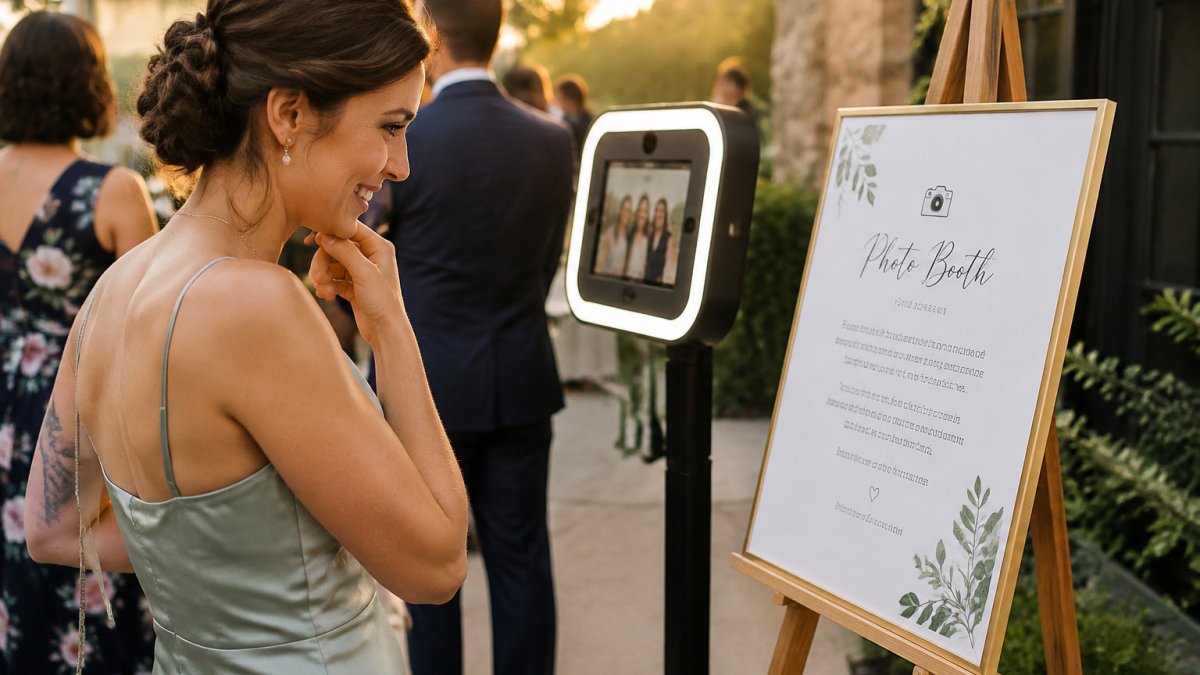
A basic sign can say:
"Photos taken in this booth are shared with the couple. By posing, you agree that your image may appear in the couple's private gallery. Photos will not be posted publicly or used for marketing without your permission."
Adjust the wording to match your actual agreement. Consent signs work best when they are visible before a guest starts the session, written in plain language, and consistent with the vendor's policy and your contract.
Handling guests who opt out
Not every guest wants to be photographed, and a consent sign only helps if there is a practical way to honor a no. Build the opt-out into the event plan:
- Brief the booth attendant, if there is one, on how to handle a guest who declines.
- Keep the booth in a spot where guests can walk past without being pulled into a frame.
- If group photos are planned, let guests step aside rather than asking them to pose and then editing them out.
- Offer a discreet alternative, such as a photo of the guest's hands, a prop, or a written message, for guests who want to participate without appearing in a public gallery.
Consent for minors
Children are often the most enthusiastic booth users and the least able to consent on their own. A parent or guardian should be present when a child uses the booth, and the consent sign should make clear that images of minors follow the same gallery rules as everyone else's. If a parent asks that a child's photos not appear in the shared gallery, honor it and tell the vendor.
Making the sign do its job
- Put the sign where guests see it before they enter the booth, not after.
- Repeat the key point on the booth screen if the vendor supports a custom start screen.
- Keep a copy of the sign wording with your contract so it matches the vendor's policy.
- If the gallery is private, say so on the sign, guests relax when they know the photos are not public.
Watch out: a sign that says photos are private while the vendor's default gallery is public searchable creates a false promise. Confirm the gallery settings before the event and align the sign wording to them.
Photo Booth Image Retention Policy: How Long Photos Should Be Kept
A retention policy sets how long images stay on a system after the event. Decide this with your vendor before the wedding. Ask whether copies are removed after a set period, and confirm that you can request deletion.
Consider these points when setting a policy:
- Couple's copy: Keep the full set in a secure location you control.
- Vendor's copy: Ask how long the vendor stores the files and when it deletes them.
- Deletion request: Get written confirmation that the vendor will remove images on request.
Clear retention terms protect guests who prefer their photos not to live on a company server indefinitely.
Setting Up a Private Digital Photo Booth Gallery
A private gallery lets your guests view and download photos without making them public. Choose a platform that requires a link or password. Share the link only with guests you invite.
Steps to set up a private gallery:
- Pick a gallery service that supports password protection.
- Set the gallery to private rather than public.
- Share the link and password only with invited guests.
- Turn off public search and social sharing options.
- Remove or archive the gallery when your sharing window closes.
Confirm these settings before the event so you are not adjusting them under pressure.
Booking a Photo Booth With Privacy in Mind
When you book, bring your privacy questions and your consent plan. Compare vendors on how clearly they explain data handling, not just on price or booth style. Look for:
- A written privacy or data policy
- Clear answers about ownership and storage
- A process for deleting guest photos
- Willingness to follow your consent wording
Booking with these points settled lets you enjoy the booth knowing your guests are protected. When you are ready, you can check availability and submit your event details to confirm your date.
Frequently Asked Questions
Are photo booth pictures private?
Photo booth pictures are only as private as the vendor's settings and policies make them. Ask whether photos go to a private, password-protected gallery or a public link, who on the vendor's team can access them, and whether guests can request removal. Enclosed booths offer visual privacy while guests pose, but that does not control what happens to the image after it is taken. Get the answers in writing before you book.
Can a photo booth company post wedding photos without permission?
A vendor should not post guest photos publicly without permission, and your rental agreement should say so. Confirm whether the company uses images for its own marketing or social media, and ask for an opt-in rather than an opt-out. Couples can add a line to their contract that restricts marketing use. If the vendor will not commit to this in writing, look for another provider.
How long should a photo booth company keep wedding photos?
The answer comes from the vendor's written retention policy and your agreement. Ask how long galleries stay live after the event, when originals are deleted, and whether you can request earlier deletion. A clear end date that you can confirm in the contract is more useful than a promise to keep photos indefinitely.

Frequently asked questions
Are photo booth pictures private?
Photo booth pictures are only as private as the vendor's settings and policies make them. Ask whether photos go to a private, password-protected gallery or a public link, who on the vendor's team can access them, and whether guests can request removal. Enclosed booths offer visual privacy while guests pose, but that does not control what happens to the image after it is taken. Get the answers in writing before you book.
Can a photo booth company post wedding photos without permission?
A vendor should not post guest photos publicly without permission, and your rental agreement should say so. Confirm whether the company uses images for its own marketing or social media, and ask for an opt-in rather than an opt-out. Couples can add a line to their contract that restricts marketing use. If the vendor will not commit to this in writing, look for another provider.
How long should a photo booth company keep wedding photos?
The answer comes from the vendor's written retention policy and your agreement. Ask how long galleries stay live after the event, when originals are deleted, and whether you can request earlier deletion. A clear end date that you can confirm in the contract is more useful than a promise to keep photos indefinitely.